Consciousness + Commitment = Change.According to the CIW online database
headquarters “The CIW is a community-based organization of mainly Latino, Mayan
Indian and Haitian immigrants working in low-wage jobs throughout the state of
Florida.”The CIW’s efforts gear towards
the equality of fair wage, respect in the work environments, cheaper housing,
stronger laws and enforcement, and end to involuntary servitude in the fields. The
CIW represents a struggle for justice in their fight for visibility.Their disruptance include such movements as
the Anti-Slavery Campaign and the Campaign for Fair Food.With the Anti- Slavery Campaign CIW was able
to gain national and international recognition to the investigation against
involuntary servitude as well as build awareness to human rights education.
CIW establishing a powerful new voice for the respect of human rights
The CIW’s Campaign for Fair Food began as a farmworker
boycott targeting one of the largest fast food giants in the nation; Taco
Bell.The CIW’s goal was for these
leading fast food corporations to take responsibility for human rights abuse in
the fields where their produce is grown. The consumers played a role in this
boycott when the “Boot the Bell” boycott spread through high school and college
campuses across the nation.With the refusal
of purchasing Taco Bell products, the powers now lied in the hands of the consumers.Due to consumer power the demands to improve
wages and working conditions for Florida tomato pickers was met.But it did not end here.Now that The Coalitional of Immokalee Workers
has established a voice in the mainstream media, it was time to keep their
movement going.The CIW collaborated
with other leading fast food branches such as McDonalds, Burger King and Subway
striking a deal with growers to raise workers’ pay and to create an industry
code of conduct, a health and safety program and a system to resolve worker complaints.
50 Pounds of Tamoto?
Or 10 cents of labor.
With these many accomplishments lead to the birth of the “One
Penny More” movement.The intention of
this campaign was to build a voice for unjust wages and Fair Trade, asking for
one more penny for every pound of tomato that was picked.The purpose was not to only increase the
wages of the workers, but to build awareness on the concept behind asking for “one
more penny.” The very minuscule request in asking for one more penny, instead
of 5, 10 or 25 showcased the reluctant compromise of these large corporations. The
CIW faced challenges in how much power these corporations truly possessed.They were very aware that many of the farm
workers were illegal immigrants and were not supported under U.S. labor
protection laws.According to an
editorial in the New York Times, “The Florida Tomato Growers Exchange, which
represents 90 percent of the state’s tomato growers, still fought back,
threatening huge fines against members who participated. The extra pay sat in
escrow.”
Another group striving for justice in today’s society is La
Via Compesina. La Via Compesina is “a transnational agrarian movement made up
of organizations of peasants, small- and medium-scale farmers, rural women,
farm workers and indigenous agrarian communities throughout Asia, the Americas,
Europe and Africa. These groups all share an intimate connection to the land
and a collective will to work together to build a more humane world”
(Desmarais, Navarro 2009).La Via
Compensina has become one of the most powerful voices of resistance towards
globalization and the corporate model of agriculture.These movements build awareness on the funds that
are systematically displacing farmers and undercutting local economies and food
traditions.Their disruptance coincides
with The Coalitional of Immokalee Workers (CIW) in the fight to overcome Invisibility
and injustice working environments.We must
not conform to the bottleneck corporations.
THE STAGES OF YOUR FOOD
Tuesday, November 15, 2011
1.) Richard Lobb of the National Chicken Council says in the
film, “In a way, we’re not producing chickens, we’re producing food.” What does
this statement mean? Do you agree or disagree with it? How might this
perspective affect the way that chickens are raised?
I strongly agree with
Lobb’s statement of “In a way, we’re not producing chickens, we’re producing
food.”The foods we are consuming today are
not being naturally produced.With all
of the chemicals, GMO’s, chemical additives and human growth hormones etc. that
are being injected into our foods, the end product has become something taken out of God’s will and entirely created
by man.Lobb’s statement is implying
that we are just creating a product for the demand of fulfilling the populations
societal needs.Everything has essentially
fallen under one distinctive category; Food.We are no longer producing chicken for the sake of consuming the real
product of chicken or poultry.We are no
longer harvesting vegetables such as corn or potatoes or rice for its purposeful
enriched flavors.We have instead
created such foods to make other products, to feed the consumer, and take any
character out of the natural production of that product.Our goal is to preserve and mass produce for
the consumers, bringing in the highest income possible at the cheapest
cost.Chickens and other animals are no
longer naturally grazed, but are drugged and treated inhumanely to increase
production rates.We have outsourced so
much that our food is no longer food, but instead a result from the cheap labor.In a sense it can no longer be considered as
food, but just another product on the shelf.
2.) In the film, food science professor Larry Johnson says,
“If you go and look on the supermarket shelf, I’ll bet you 90 percent of [the
products] would contain either a corn or soybean ingredient. And most of the
time, it’ll contain both.” Why might it be a problem that the majority of our
food is made mostly from just corn and soybeans—so that nearly everything we
eat contains them?
There are many truths that lie within Professor Johnson’s
statement.After personally researching
items in the supermarket that contain either corn or soybeans, I too found that
there were overwhelming results.Almost every
item that I picked up contained either corn or soybean ingredients in the
product.This becomes a problem because
much like the previous discussion with the chicken being interpreted as just “food,”
these “products” containing corn and soybeans can also be considered as “fake”
food as well.It is ultimately leveling
the playing field for nutrients within foods and altering the natural process of
production.The health content of meat
products can be compared to that of a cracker because they contain the same
ingredients.Corn and soybeans are also
some of the easiest products to mass produce, making it easier for large
industries to create products by utilizing the fewest and most common ingredients.Once again we are blind to these tactics and
fall for the most appealing products.
3.) In the film,
union organizer Eduardo Peña says, “We want to pay the cheapest price for our
food. We don’t understand that it comes at a price.” Do you agree or disagree
with him? What evidence do you see in the film that led you to agree or
disagree? What evidence do you see in your life that informs your position as
well?
I completely agree with Pena’s statement.As consumers we have fallen for the products
that are introduced to us at the cheapest price.We don’t understand that these cheap foods
are being produced in a way that makes it un-equivalent to real food.The production tactics of these industries
fall under inhumane treatment of the animals, inhumane treatment to the service
workers and employees and inhumane treatment to us as consumers.These products that have been stuffed with
additives, chemicals and exposed to diseases due to unsanitary conditions are
all in the long run affecting us consumers.Evidence that support Pena’s claim is in the value menus that were
stressed in the film.How come we are
able to get so much food at such a low cost, and how are they producing it all?
We have unconsciously allowed these industries to reconstruct the face of our
diets by introducing an easier, faster way of life.Personally I would have to admit I go for foods
in the grocery store that are on sale and items on the menu that would
essentially get me the fullest at the cheapest cost.Our generation doesn’t realize the health risks
of these products that we are consuming and the fictitious lifestyle that these
corporations are creating to appeal to the audiences. We are no longer in
control, they have created the norm and have made it so we essentially have to
demand their products.
4.) As portrayed in the film, cost and efficiency drive our
current food system. Should price be the most important force behind our food
industry? Why or why not? How might our food system change if it was driven by
other values, like health or environmental sustainability?
In the economically
distressed times we are facing I believe that cost and efficiency has played a
very large role in our current food systems.This stems from the working household of balancing time, providing for
the family and saving the most money.These
corporations have feed off the fact that cost and availability are some of our society’s
major weaknesses.Although we are very
sympathetic about our health and environmental sustainability, these goals are
not feasible at this time.It is
difficult to drastically change the way we eat, what we consume and how much we
spend, just to ensure a healthier lifestyle.And that’s the thing; corporations are knowledgeable of this concept and
distance themselves more and more from the quality of their products, the
sanitary environments and humane treatments of animal production, and the
overall wellbeing and health of the consumer.These industries are ignorant and don’t understand that they have the
power to deplete any health risks our nation is facing through the consumption
of their products.Such disorders as diabetes,
obesity, and heart disease will drastically decrease, due to the products with high
fats and sugar contents no longer being produced.Environmental sustainability would increase
as well due to the decrease in facilities, factories and pastures that are
involved with this mass production.If the
drive of the food industry is even slightly shifted towards another direction,
all of our lives would drastically change for the better.
5.) Saving seeds from each year’s crop is a tradition
farmers have followed for thousands of years. Think of a tradition that has
been in your family for a long time. What if you could no longer have this
tradition because someone now legally claims it as theirs?
The restriction of
farmers being able to save their seeds is one that stems from the fact that Monsanto
has consumed all power over farming production.Even though seed saving was once a tradition it has now turned into a
lawsuit that cost so much it is not worth the battle.Seed sanitation tools being banned and lists
being compiled of independent farmers that have decided to not be owned by
Monsanto has created a hostile situation that takes away the sanctity and
tradition of seed saving and harvesting.These farmers lose all hope and are stripped away from any moral values
they had about food production.My family
doesn’t have any traditions that we participate in, but to put the situation
into context I could imagine the possibility of holidays such as Christmas and
Thanksgiving being taken away from us.These
are traditions that we celebrate every year. The memories that we create from
family gatherings and traditions that we value on these days would no longer
exist because of one company’s desire to withhold all power.I couldn’t imagine something that has become
a norm within our society and within my family to be taken away from me due to
someone’s fear of competition.
6.) In the film, author Michael Pollan says, “I think that
one of the most important battles for consumers to fight is the right to know
what’s in their food and how it’s grown.” How does his position compare with
the California Farm Bureau’s position?
Pollan’s position on
the topic of ingredient awareness provided on labels is something I believe
needs to be implemented on all products.The California Farm Bureau believes differently for they feel as if this
information would cause unnecessary fear.If knowledgeable of where our food was produced, how it was produced,
what additives it contains and what is actually being consumed into our bodies,
us as consumer would most likely not buy these products.He then suggests alternative ways to avoid
these products such as buying foods from farmers markets and local
growers.This would provide us with a
more educated outlook on all of the information Pollan believes should be
incorporated on the labels.
7.) Do you think the film privileges the experiences and
dilemnas facing people in the United States?Why and why not
I believe this film
does privilege the experiences and dilemmas facing people in the United States,
for it exposes a whole side of the food system that our nation is uneducated
on.It showcases where our power lays,
who is in control, how we have fallen for their tactics and what ultimately
needs to be done to begin a movement.It
highlights the hard facts of what is truly occurring behind the scenes, where
our food is coming from, the environment it is produced in, and how we are all
blindly accepting these threats.With this
information it is truly up to our own interpretation.This dilemma that the people of our nation
are facing needs to be solved by our own interdependence.We have become so reliant on these
corporations to mass produce; we are essentially feeding to the problem and
giving them the ability to create these products.We call for demand and they provide.It will forever be a dark ongoing cycle of
societal give and take.
8.) Overall reaction to film?
I’ve seen
this film several times before and I always seem to learn something new each
time.I believe it is a great resource
to build public awareness on a dark issue our nation is facing.Even though it provides many suggestions on
how to solve these problems, I feel as if this has grown so large it is out of
our control.This may sound like a statement
of resistance, but if you think about it realistically how can the average
working class adult, struggling to provide for their family able to change
their lives just to create a healthier lifestyle.Where do we find the time to prepare these
healthy meals, go to the farmers markets; that are further away and more
costly, and work all at the same time.It
all comes back to the concept of availability, accessibility and accountability.How available is this food when we
The term poultryrefers to
domesticated fowl raised for meat or eggs.Farms will keep hens to produce eggs for human consumption or for
breeding purposes and others concentrate on raising chickens or turkeys for
meat production.According to the Economic
Research Service/ USDA in the 1940s, agricultural research brought new
technologies to the poultry industry. Included were the introduction of new breeds
for meat, better nutrition and disease control, better management of confined poultry,
processes that correctly sexed chicks, and the candling of eggs. These
practices introduced U.S. farmers to the possibilities of raising broilers and
fryers for commercial consumption.
This act of poultry production for commercial consumption
has turned into something so desensitized and inhumane.The factories practicing in intensive chicken
farming are raising their chickens in rows of cages with lights to mimic
sunlight, environments consisting of one large climate controlled housing where
they live in their feces and are fed antibiotics in their water and food to
kill diseases, which end up in our human consumption.The raising quarters are so small and close that
the chickens are de-beaked to avoid the killing off of other chickens.From these conditions these chickens suffer
from ammonia and physical deformities as well as the presence of E. coli.Rough handling of the chickens by the farm
workers, slaughtering while still conscious and poor transportation also play a
large part in the inhumane aspect of poultry production.Another form of chicken production is
Selective breeding where bigger chickens are chosen to create heavy breasted
birds.Or farmers can go to the extent
of utilizing growth hormones in their production.
These growth hormones make it so the chickens grow larger,
live less and produce more products.As you
have seen in the stores these chicken breast are larger than ever, but
something we fail to realize about these chickens are the multiple additives
injected into these meats such as water and other soluble products to make them
appeal larger.The larger the product the more revenue it
will produce.The average value of
poultry production according to the Value
of production on farms with any poultry production in 1995 data collected
by the Economic Research Service/ USDA was $3,029,070 for all farms with gross
annual sales of over $1,000,000.This statistic
shows that this industry is growing due to the increase in demand.
We must understand where our food originates from.We buy products from large corporations such
as McDonalds and Walmart who are the number one clients and supporters of these
intensive farming agencies.We must be
educated on the production of our food and obtain food sovereignty.It is our choice to have our chickens to be
raised free ranged without any of the additives and increase of cost due to the
“organic, natural” state it was produced.The justice of food production and animal cruelty needs to have a voice
and gain public awareness.As consumers
we are ultimately allowing these genetically altered foods to enter our
bodies.And we must no longer provide
these leading corporations with the opportunity to change the face and security
of our foods.
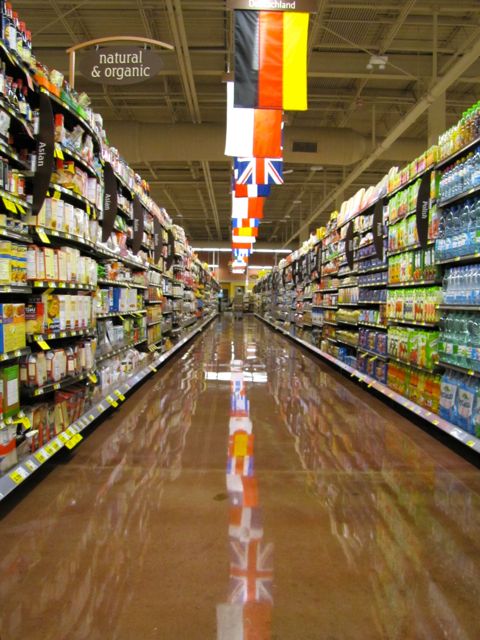
When going to the grocery store I wasn’t expecting much to
be directly marketed towards me personally.I thought “alright when I shop where do I go to first?”I usually end up towards the vegetables
because they are the very first thing I see when entering the grocery store.And then I thought again and realized that
the vegetables were displayed at the front of every store I have ever been in! Now purposely trying to avoid the vegetables I started to realize that everything was geared towards one demographic, and
that was mine; the male demographic.I found
chips, racks and racks of beer, sodas, chilies, soups and platters all
revolving around one thing; Game Day.There
were sales on thirty racks of beer, buy one get one free bags of chips, 2 for
5.99 boxes of soda and 99 cent cans of Chunky “Man Soup.”Being in
a college town tail gaiting and college “weekend recreational activities” were
all a target in this store.The labels
and advertising of these foods were also geared towards men.Football players, half naked women and
athletic teams were all incorporated into the design of the product, playing
off the notion of “this person promotes this product, so I must buy it.” After realizing
that I have completely fallen for all of these marketing schemes before, I began
to think about the second task of what it would be like if I were someone else
shopping for these products and if companies did the same thing to them.
I began by imagining what it would be like if I were a women
shopping, but then began to realize that the audience most targeted by these
companies were children.All of the
cereals we eat, all of the sodas we drink, all of the candy we consume, all of
the snacks and unhealthy products that were known to be our guilty pleasure
were geared towards the desires of children.Cartoon characters, bright colors, catchy slogans and iconic figures
covered the faces of these labels.I also
noticed that everything was at eye level of a child or of the seat of the
grocery cart.Every name brand product
was towards the middle of the shelves.The
worst part is you begin to realize that all of these things are also located at
the checkout stand where you have to wait for days to pay for your groceries
and all you end up doing is reading the magazines while your kid begs for
candy.
The placing of food is crucial in the marketing strategies of
these leading corporations.Mapped out
the vegetables, meats, breads and dairy products are all located on the
outskirts of the store.You can call
these the “real foods” and the “processed foods” were in the middle.Candy was in the very first aisle, followed
by cereals, canned foods, chips, beer/ drinks, frozen foods, and then all the
way tucked in the back is the essentials of milk, orange juice and eggs.The three things that are most likely run out
first in your house hold are strategically placed in the back corner so you
have to walk through everything else to reach them. After walking about a half mile through the
store you are reminded that you forgot to grab something else you needed,
distracting you from your ultimate goal of that one gallon of milk.You then walk out with a bill of fifty
dollars instead of the initial five that you were originally supposed to
spend.
As we go through the grocery store we also begin to realize
all of the different choices we have for this one product.How come we need so many varieties of cereals
or so many varieties of sodas, chips, vegetables and meats?In reality we are only choosing from about
seven to ten due to the small bottle neck corporations that are leading the
human consumption.But we are at fault
too.We are falling for their conniving marketing
tactics and are demanding they supply these products.But we won’t stop here, with even newer
products that we will like are produced we will begin to demand more and more and
this becomes a large cycle feeding to the larger food chain.Yes these corporations are at blame because
they are hypnotizing us and our younger generations to consume their products,
but we are ultimately the ones who are giving them this power.
I wanted to begin my analysis by addressing the 10 items that
have corn or soybean as an ingredient.I
know we were told to only go down the middle aisle and look for 10 items, but I
wanted to make it a little more interesting and look for items that I like to
eat and or have eaten most commonly in the past. Before going to the store I had
to educate myself on what ingredients consisted of corn as well.I found that baking powder, corn oil, corn
syrup, fructose, gluten and high fructose corn syrup all contained some kind of
corn. What I found was most disturbing.Everything that I had chosen consisted of corn or soybeans; literally
everything! Here was my list.
Foods Containing Corn:
1.Oreos
2.Capri Suns
3.Sprite and Pepsi
4.Powerade
5.Sara Lee’s whole grain bread
6.Kellogg’s Raisin Bran Cereal/ Special K
7.Pop Tarts
8.Heinz Ketchup
9.Pop Tarts
10.Wheat Thins
Foods Containing Soybean:
1.Soy Sauce (any Asian food pretty much!!)
2.Mayonnaise
3.Whey protein
4.Many Chocolate Bars
5.Chunky Soups
It’s appalling to even think about foods such as wheat thins
and different beverages we consume all contain corn based products.It even goes as far as poultry items and
different kinds of meats that are made up of these ingredients.Items that aren’t supposed to be made of multiple
ingredients are taken away from their own pureness and has been modified so greatly
it has turned into a combination of crap thrown together to become that one product.It makes me not even want to buy or consume
these products.But at the same time how
can we all stop ourselves from living the life we have always known.
After analyzing the clip “What is The Center for Consumer Freedom,” I have found that this video is essentially implying that organizations such as PETA and the Humane Society don’t build public awareness, but instead are very deceptive and conceiving.This clip also addressed the issue of the government’s involvement with the choice in what Americans should eat.They believe that these organizations shouldn’t become a factor into the choices one makes on how healthy their diet is.The “bottleneck corporations” are truly the ones who hold the power in what we eat.The accessibility and media advertisements of the foods sold in stores and in restaurants by these large corporations is what has sent our nation into the obese epidemic we are facing today.They are targeting families in the middle class and lower income housing with cheaper processed foods that are more accessible and extremely subdued in preservatives.We have fallen under the spell of their marketing scheme.
We can’t help but consume these products because it is all we know.We can’t change the way we live just to “fix” the problem.Instead, we have become complacent and show empathy about what is happening, but will never take the initial steps to start a movement.Cost of all natural foods in comparison to these cheap processed foods that produced by these “bottleneck corporations” keep us all from making any progress.It is difficult especially in times of economic distress to make a full lifestyle change.We can say we will no longer consume these products due to personal values and beliefs, but how long does this last when facing the other challenges life has to offer. Consumption can be a playing factor in facing these markets in the sense we are in control of their revenue, but how much of the population has decided to rebel.The constraint of time has also become an issue when being the provider of your family conflicts with your profession.It is inevitable that you will gear towards those quick restaurants that serve these unhealthy foods, or buy groceries that are sponsored by these larger corporations to make your “life that much easier.” It is difficult to take the several hours of food preparation to provide a healthy good quality meal for your family.It has become this ongoing self-dialogue that will never be faced until these markets are challenged.
Internationalism is the basis and principle of cooperation among the nations, as well as the promotion of the common good and the devotion of interest to each nation.In this video clip provided by the “center of consumer freedom” I have found that it neglects any sense of the definition of this concept.This video is implying that these organizations are not providing honest information, but instead are using sympathetic tactics to draw attention to their foundations.By attacking these organizations the center of consumer freedom is going against the greater good.This also insists that these corporations should be in control when in all reality they are the ones who are outsourcing their products to third world countries for the cheapest production.This ties into the contradiction of labor laws and slavery that is occurring within these factories and plantations.Internationalism is not being addressed because these larger corporations have created a gap between powers among these countries facing economic depressions taking advantage of their service and resources.
How this ties into the issues of racism, sexism, class, and location is when consumer markets are targeting demographic groups that fit into these stereotypes.For an example they are marketing towards lower class minority families through accessibility and cost. Class and racism occurs when the corporations marketing tactics are geared towards Mexican and African American families who can’t afford anything else but their products. Sexism occurs when these goods revolve around “what men are supposed to eat” while watching the big game and what is considered to be the savory foods and sweets that are most commonly consumed by females.Children are also targeted when the unhealthiest products are framed around what is most desirable for youth, placing such items at eye level with bright colors and identifiable media figures, playing into the location and placement of these products.All of these discriminatory actions are taken in consideration when producing these goods, but are purposely done to receive the most income.
As Patel has addressed in his book “Stuffed and Starved: The Hidden Battle for the World Food System,” we are blinded by what these corporations have provided in our supermarkets.Even though it may seem like we have plenty of options, we driven towards the appeal of the products that are controlled by these larger corporations.There may be hundreds of types of apples, but in reality we only buy about five of them due to the marketing strategies led by these corporations.They are truly in control of human consumption and are making it so their product is what is in highest demand.We no longer have a voice and the power of our consumption has become invisible.
“Taking a stand while sitting down” The Disability Rights Movement is one that I hold very near and dear to my heart.This movement is the fight to secure equal opportunities and equal rights to those who have been denied equality, independence, autonomy, and full access of society due to their physical and mental disabilities.The goal of this movement is to demand accessibility and safety among transportation, equal opportunity in employment, education and housing.Gaining acceptance in the workforce and education is an ongoing battle for disability development advocates. To gain the attention of the commons, actions such as boycotts, riots, protests and marches have all been used to gain public awareness.In the 1960’s after the Civil Rights Movement of African Americans, Women and other Minorities, this was the perfect time to gain acceptance for those born with a hearing or seeing impairment, and other forms of physical and mental disabilities.
In 1970 the Disability Rights Movement demanded Congress to add a voice of civil rights for people with disabilities in the 1972 Rehabilitation Act.The act was passed by Nixon in 1973 and marked a historical shift in civil rights.This was the first time in history where the civil rights of the disabled population would be protected by law.From this act came the IDEA (The Individuals with Disabilities Education Act) which provided education to children with disabilities.
The ADA (Americans with Disabilities Act) signed in 1990 was one of the most instrumental strides in gaining equality among the disabled population.The purpose of this act was to ensure equality and end employment and education discrimination to those with disabilities.With the access to jobs that were not available before, people with disabilities were now given the right and the ability to live independently receiving personal income.Public education programs that assisted these individuals to receive the attention needed to obtain the same education as others around them was also addressed among the population.The ADA was a great outlet to increase communication and visibility to those with disabilities.With this new found voice accessibility through architecture was taken in consideration to those in wheel chairs and other assisting devices.Ramps, elevators, railings, special seating on public transportation, restrooms and cross walks are now all configured to fit the needs of the disabled population.It was now up to our nation to fully participate in the inclusion and integration of individuals with disabilities into our society.
The reason why this movement has affected me so personally is this past summer I was blessed with the opportunity to work with a youth inclusion day camp at my local recreation center.This program gave children with disabilities the opportunity to participate in activities that revolved around the concept of a healthy lifestyle through diet, exercise and athletics.In the summer day camp, these children were treated equally as if they were just like the other kids.Ranging from ages of 6 to 11 these kids were able to build relationships in early childhood development that wouldn’t make them feel excluded from the rest of the population.We shouldn’t live in a world where the uniqueness of others is ridiculed and alienated, but instead accepted and cherished.





 There are many truths that lie within Professor Johnson’s
statement. After personally researching
items in the supermarket that contain either corn or soybeans, I too found that
there were overwhelming results. Almost every
item that I picked up contained either corn or soybean ingredients in the
product. This becomes a problem because
much like the previous discussion with the chicken being interpreted as just “food,”
these “products” containing corn and soybeans can also be considered as “fake”
food as well. It is ultimately leveling
the playing field for nutrients within foods and altering the natural process of
production. The health content of meat
products can be compared to that of a cracker because they contain the same
ingredients. Corn and soybeans are also
some of the easiest products to mass produce, making it easier for large
industries to create products by utilizing the fewest and most common ingredients. Once again we are blind to these tactics and
fall for the most appealing products.
There are many truths that lie within Professor Johnson’s
statement. After personally researching
items in the supermarket that contain either corn or soybeans, I too found that
there were overwhelming results. Almost every
item that I picked up contained either corn or soybean ingredients in the
product. This becomes a problem because
much like the previous discussion with the chicken being interpreted as just “food,”
these “products” containing corn and soybeans can also be considered as “fake”
food as well. It is ultimately leveling
the playing field for nutrients within foods and altering the natural process of
production. The health content of meat
products can be compared to that of a cracker because they contain the same
ingredients. Corn and soybeans are also
some of the easiest products to mass produce, making it easier for large
industries to create products by utilizing the fewest and most common ingredients. Once again we are blind to these tactics and
fall for the most appealing products.  I completely agree with Pena’s statement. As consumers we have fallen for the products
that are introduced to us at the cheapest price. We don’t understand that these cheap foods
are being produced in a way that makes it un-equivalent to real food. The production tactics of these industries
fall under inhumane treatment of the animals, inhumane treatment to the service
workers and employees and inhumane treatment to us as consumers. These products that have been stuffed with
additives, chemicals and exposed to diseases due to unsanitary conditions are
all in the long run affecting us consumers.
Evidence that support Pena’s claim is in the value menus that were
stressed in the film. How come we are
able to get so much food at such a low cost, and how are they producing it all?
We have unconsciously allowed these industries to reconstruct the face of our
diets by introducing an easier, faster way of life. Personally I would have to admit I go for foods
in the grocery store that are on sale and items on the menu that would
essentially get me the fullest at the cheapest cost. Our generation doesn’t realize the health risks
of these products that we are consuming and the fictitious lifestyle that these
corporations are creating to appeal to the audiences. We are no longer in
control, they have created the norm and have made it so we essentially have to
demand their products.
I completely agree with Pena’s statement. As consumers we have fallen for the products
that are introduced to us at the cheapest price. We don’t understand that these cheap foods
are being produced in a way that makes it un-equivalent to real food. The production tactics of these industries
fall under inhumane treatment of the animals, inhumane treatment to the service
workers and employees and inhumane treatment to us as consumers. These products that have been stuffed with
additives, chemicals and exposed to diseases due to unsanitary conditions are
all in the long run affecting us consumers.
Evidence that support Pena’s claim is in the value menus that were
stressed in the film. How come we are
able to get so much food at such a low cost, and how are they producing it all?
We have unconsciously allowed these industries to reconstruct the face of our
diets by introducing an easier, faster way of life. Personally I would have to admit I go for foods
in the grocery store that are on sale and items on the menu that would
essentially get me the fullest at the cheapest cost. Our generation doesn’t realize the health risks
of these products that we are consuming and the fictitious lifestyle that these
corporations are creating to appeal to the audiences. We are no longer in
control, they have created the norm and have made it so we essentially have to
demand their products.  In the economically
distressed times we are facing I believe that cost and efficiency has played a
very large role in our current food systems.
This stems from the working household of balancing time, providing for
the family and saving the most money. These
corporations have feed off the fact that cost and availability are some of our society’s
major weaknesses. Although we are very
sympathetic about our health and environmental sustainability, these goals are
not feasible at this time. It is
difficult to drastically change the way we eat, what we consume and how much we
spend, just to ensure a healthier lifestyle.
And that’s the thing; corporations are knowledgeable of this concept and
distance themselves more and more from the quality of their products, the
sanitary environments and humane treatments of animal production, and the
overall wellbeing and health of the consumer.
These industries are ignorant and don’t understand that they have the
power to deplete any health risks our nation is facing through the consumption
of their products. Such disorders as diabetes,
obesity, and heart disease will drastically decrease, due to the products with high
fats and sugar contents no longer being produced. Environmental sustainability would increase
as well due to the decrease in facilities, factories and pastures that are
involved with this mass production. If the
drive of the food industry is even slightly shifted towards another direction,
all of our lives would drastically change for the better.
In the economically
distressed times we are facing I believe that cost and efficiency has played a
very large role in our current food systems.
This stems from the working household of balancing time, providing for
the family and saving the most money. These
corporations have feed off the fact that cost and availability are some of our society’s
major weaknesses. Although we are very
sympathetic about our health and environmental sustainability, these goals are
not feasible at this time. It is
difficult to drastically change the way we eat, what we consume and how much we
spend, just to ensure a healthier lifestyle.
And that’s the thing; corporations are knowledgeable of this concept and
distance themselves more and more from the quality of their products, the
sanitary environments and humane treatments of animal production, and the
overall wellbeing and health of the consumer.
These industries are ignorant and don’t understand that they have the
power to deplete any health risks our nation is facing through the consumption
of their products. Such disorders as diabetes,
obesity, and heart disease will drastically decrease, due to the products with high
fats and sugar contents no longer being produced. Environmental sustainability would increase
as well due to the decrease in facilities, factories and pastures that are
involved with this mass production. If the
drive of the food industry is even slightly shifted towards another direction,
all of our lives would drastically change for the better. 
 Pollan’s position on
the topic of ingredient awareness provided on labels is something I believe
needs to be implemented on all products.
The California Farm Bureau believes differently for they feel as if this
information would cause unnecessary fear.
If knowledgeable of where our food was produced, how it was produced,
what additives it contains and what is actually being consumed into our bodies,
us as consumer would most likely not buy these products. He then suggests alternative ways to avoid
these products such as buying foods from farmers markets and local
growers. This would provide us with a
more educated outlook on all of the information Pollan believes should be
incorporated on the labels.
Pollan’s position on
the topic of ingredient awareness provided on labels is something I believe
needs to be implemented on all products.
The California Farm Bureau believes differently for they feel as if this
information would cause unnecessary fear.
If knowledgeable of where our food was produced, how it was produced,
what additives it contains and what is actually being consumed into our bodies,
us as consumer would most likely not buy these products. He then suggests alternative ways to avoid
these products such as buying foods from farmers markets and local
growers. This would provide us with a
more educated outlook on all of the information Pollan believes should be
incorporated on the labels. 


 These growth hormones make it so the chickens grow larger,
live less and produce more products. As you
have seen in the stores these chicken breast are larger than ever, but
something we fail to realize about these chickens are the multiple additives
injected into these meats such as water and other soluble products to make them
appeal larger. The larger the product the more revenue it
will produce. The average value of
poultry production according to the Value
of production on farms with any poultry production in 1995 data collected
by the Economic Research Service/ USDA was $3,029,070 for all farms with gross
annual sales of over $1,000,000. This statistic
shows that this industry is growing due to the increase in demand.
These growth hormones make it so the chickens grow larger,
live less and produce more products. As you
have seen in the stores these chicken breast are larger than ever, but
something we fail to realize about these chickens are the multiple additives
injected into these meats such as water and other soluble products to make them
appeal larger. The larger the product the more revenue it
will produce. The average value of
poultry production according to the Value
of production on farms with any poultry production in 1995 data collected
by the Economic Research Service/ USDA was $3,029,070 for all farms with gross
annual sales of over $1,000,000. This statistic
shows that this industry is growing due to the increase in demand.